

このスライドは会員限定コンテンツです。
今すぐアカウント登録(無料)して、続きを読みましょう!


1/43
関連するスライド
急性期医療で緩和ケアを実践する光景
柏木秀行
25362
64
【デキレジ】細菌性髄膜炎 - ERでの初期対応 -
やまて
448054
1939

熱中症診療 Active Coolingと冷却の実践
渡邉敬祐
5103
22
挿管後管理:post intubation management 気管挿管した後の最低限
石上雄一郎
163407
641
循環管理・ショックの管理

神戸朝日病院
60,321
267
投稿した先生からのメッセージ
ショックはよく出くわす病態です。その病態生理を分解して理解できていると、治療のイメージがしやすいものです。
概要
ショックについての概要をまとめました。例として敗血症性ショックを取り上げています。
本スライドの対象者
医学生/研修医/専攻医
投稿された先生へ質問や勉強になったポイントをコメントしてみましょう!
0 件のコメント



このスライドと同じ診療科のスライド


テキスト全文
循環管理とショックの基本概念
#1.
循環管理 かんぱち救急医
#2.
Shock
#3.
そもそもショックって? 血圧が低いってことやろ!
ショックの定義と病態生理
ショックの認知と評価方法
ショックの診断と管理指標
酸素供給と臓器灌流圧の重要性
ショックの管理における介入方法
敗血症とSeptic shockの理解
Septic shockの介入と管理戦略
#4.
そもそもショックって? DEFINITION Shock is defined as a state of cellular and tissue hypoxia due to either reduced oxygen delivery, increased oxygen consumption, inadequate oxygen utilization, or a combination of these processes. This most commonly occurs when there is circulatory failure manifested as hypotension (ie, reduced tissue perfusion); however, it is crucial to recognize that a patient in shock can present hypertensive, normotensive, or hypotensive. Shock is initially reversible, but must be recognized and treated immediately to prevent progression to irreversible organ dysfunction. "Undifferentiated shock" refers to the situation where shock is recognized but the cause is unclear. UpToDate:Definition, classification, etiology, and pathophysiology of shock in adults Literature review current through: Apr 2020. | This topic last updated: Jan 10, 2020.
#5.
そもそもショックって? DEFINITION Shock is defined as a state of cellular and tissue hypoxia due to either reduced oxygen delivery, increased oxygen consumption, inadequate oxygen utilization, or a combination of these processes. This most commonly occurs when there is circulatory failure manifested as hypotension (ie, reduced tissue perfusion); however, it is crucial to recognize that a patient in shock can present hypertensive, normotensive, or hypotensive. Shock is initially reversible, but must be recognized and treated immediately to prevent progression to irreversible organ dysfunction. "Undifferentiated shock" refers to the situation where shock is recognized but the cause is unclear. UpToDate:Definition, classification, etiology, and pathophysiology of shock in adults Literature review current through: Apr 2020. | This topic last updated: Jan 10, 2020. 末梢組織の低酸素状態 ↓ 臓器障害
#6.
酸素需給バランス 供給 需要 O2 何かが起こって・・・!
#7.
酸素需給バランス 供給 需要 供給が減る 消費が増える 利用ができない
#8.
酸素需給バランス Glucose Pyruvic acid Lactic acid TCA cycle -O2 +O2 36ATP Aerobic Anaerobic 2ATP
#9.
酸素需給バランス Glucose Pyruvic acid Lactic acid TCA cycle -O2 +O2 36ATP Aerobic Anaerobic 2ATP
#10.
その患者はショックですか?
#11.
ショックを認知する:3つの窓 灌流の3つの窓:臓器灌流障害の指標 脳 意識状態 皮膚 Mottling score Livedo reticularis CRT 腎臓 尿量(0.5ml/kg) ※目安 N Engl J Med 2013; 369: 1726-34
#12.
ショックを認知する:3つの窓 灌流の3つの窓:臓器灌流障害の指標 脳 意識状態 皮膚 Mottling score Livedo reticularis CRT 腎臓 尿量(0.5ml/kg) ※目安 N Engl J Med 2013; 369: 1726-34 血圧は?
#13.
ショックを認知する Cryptic shock 低血圧を伴わないショックのこと 死亡率は血圧低下を伴うショックと同等
#14.
ショックに対応する:VIP rules Ventilate 酸素投与 Infuse 輸液 Pump 循環作動薬 Crit Care 16: 239, 2012.
#15.
ショックを検索する:RUSH exam Rapid Ultrasound in SHock in the evaluation of critically ill patient 目標5分以内 図:救急超音波テキスト-point of careとしての実践的活用法 RUSH examの報告:Emerg Med Clin North Am. 2010; 28: 29-56.
#16.
ショックを分類する Hypovolemic 出血性 体外への喪失(嘔吐・下痢) 血管外への喪失(熱傷) Distributive 感染症 アナフィラキシー 神経原性(頸髄損傷) Cardiogenic 心筋性 不整脈性 機械性(弁膜症、穿孔) Obstructive 心外からの圧迫 タンポナーデ・緊張性気胸 心収縮障害 肺血栓塞栓症
#17.
その患者はショックから 離脱できていますか?
#18.
酸素需給バランス 供給 需要 O2 酸素供給量 DO2 酸素消費量 VO2
#19.
酸素需給バランス 供給を増やす 需要 酸素供給量 DO2
#20.
酸素供給を増やす どれだけ酸素が運ばれてるのか? 正常値:1000ml/min DO2(ml/min) = CO(L/min) × CaO2(ml/dL) × 10 ※単位合わせ SV(ml) × HR 1.38 × Hb × SaO2 + 0.003 × PaO2 前負荷・心収縮力・後負荷 介入できるのは 前負荷・心収縮力・後負荷・HR・Hb・SaO2
#21.
酸素供給を増やす どれだけ酸素が運ばれてるのか? 正常値:1000ml/min DO2(ml/min) = CO(L/min) × CaO2(ml/dL) × 10 ※単位合わせ SV(ml) × HR 1.38 × Hb × SaO2 + 0.003 × PaO2 前負荷・心収縮力・後負荷 介入できるのは 前負荷・心収縮力・後負荷・HR・Hb・SaO2 血圧は?
#22.
血圧は何に必要か 臓器に血流を流すためには「圧」が必要 →「臓器灌流圧」が「臓器灌流量」を規定する 入口圧 - 出口圧 灌流圧 = MAP - RAP = MAP - CVP オームの法則:V=RI を用いて V:灌流圧、R:血管抵抗、I:流速=拍出量 = CO × SVR/80 ※80は単位補正 SV(ml) × HR 前負荷・心収縮力・後負荷 介入できるのは 前負荷・心収縮力・後負荷・HR・SVR
#23.
「酸素供給量」+「臓器灌流圧」
#24.
臓器への酸素供給を増やす 酸素供給量(DO2) CaO2 × CO 臓器灌流圧 CO × SVR
#25.
臓器への酸素供給を増やす 酸素供給量(DO2) CaO2 × CO 臓器灌流圧 CO × SVR 1.38 × Hb × SaO2
#26.
臓器への酸素供給を増やす 酸素供給量(DO2) CaO2 × CO 臓器灌流圧 CO × SVR 1.38 × Hb × SaO2 SV(ml) × HR 前負荷・心収縮力・後負荷
#27.
臓器への酸素供給を増やす 酸素供給量(DO2) CaO2 × CO 臓器灌流圧 CO × SVR 1.38 × Hb × SaO2 SV(ml) × HR 前負荷・心収縮力・後負荷 輸血 酸素
#28.
臓器への酸素供給を増やす 酸素供給量(DO2) CaO2 × CO 臓器灌流圧 CO × SVR 1.38 × Hb × SaO2 SV(ml) × HR 前負荷・心収縮力・後負荷 輸血 酸素 補液
#29.
臓器への酸素供給を増やす 酸素供給量(DO2) CaO2 × CO 臓器灌流圧 CO × SVR 1.38 × Hb × SaO2 SV(ml) × HR 前負荷・心収縮力・後負荷 輸血 酸素 補液 PM カテコラミン
#30.
ショックの管理の指標は? 組織の酸素化をモニタリングする必要がある ↓ 直接モニタリングする術はない
#31.
酸素消費量を考える どれだけ酸素が使われたのか? 正常値:200 〜 250mL/分 120 〜 160mL/分/m2 VO2(ml/min) = 動脈酸素運搬量DO2 – 静脈酸素運搬量DvO2 = (CO × CaO2) – (CO × CvO2) = CO × (CaO2-CvO2) = CO × Hb × 13.8 × (SaO2-SvO2) ※単位合わせに ×10 酸素需給バランスの指標に重要 正常値:75% 酸素の残りカスをみている → 低い = 酸素消費が多かった!
#32.
Septic Shock
#33.
Sepsis/Septic shock 定義 日本版敗血症診療ガイドライン 2016 The Japanese Clinical Practice Guidelines for Management of Sepsis and Septic Shock 2016 (J-SSCG2016):https://www.jsicm.org/pdf/jjsicm24Suppl2-2.pdf Schottmüllerら 1914年 「敗血症は微生物が局所から血流に 侵入した病気」として「菌血症 = 敗血症」の概念 Boneら 1989年 septic syndrome(セプシス症候群)という概念。菌血症と無関係に臓器不全が起こる。
#34.
■敗血症の定義 「感染症に対する制御不能な宿主反応に起因した生命を脅かす臓器障害」 ■敗血症の診断基準 ICU 患者とそれ以外(院外,ER,一般病棟)で区別する。 ICU 患者:感染症が疑われ,SOFA 総スコア 2 点以上の急上昇があれば,敗血症と診断する。 非 ICU 患者:quick SOFA(qSOFA)2 項目以上で敗血症を疑う。最終診断は,ICU 患者に準じる。 Sepsis/Septic shock 定義 Sepsis-3 2016年 日本版敗血症診療ガイドライン 2016 The Japanese Clinical Practice Guidelines for Management of Sepsis and Septic Shock 2016 (J-SSCG2016):https://www.jsicm.org/pdf/jjsicm24Suppl2-2.pdf
#35.
SOFA score 日本版敗血症診療ガイドライン 2016 The Japanese Clinical Practice Guidelines for Management of Sepsis and Septic Shock 2016 (J-SSCG2016):https://www.jsicm.org/pdf/jjsicm24Suppl2-2.pdf
#36.
SOFA score 日本版敗血症診療ガイドライン 2016 The Japanese Clinical Practice Guidelines for Management of Sepsis and Septic Shock 2016 (J-SSCG2016):https://www.jsicm.org/pdf/jjsicm24Suppl2-2.pdf A(Air:呼吸P/F ratio) B(Blood:凝固Plt) C(Circulation:循環) D(意識:GCS) は 肝(肝機能:Bil) 腎(腎機能:Cre)
#37.
qSOFA 日本版敗血症診療ガイドライン 2016 The Japanese Clinical Practice Guidelines for Management of Sepsis and Septic Shock 2016 (J-SSCG2016):https://www.jsicm.org/pdf/jjsicm24Suppl2-2.pdf 意識変容はGCS<15
#38.
Septic shockを認知する 日本版敗血症診療ガイドライン 2016 The Japanese Clinical Practice Guidelines for Management of Sepsis and Septic Shock 2016 (J-SSCG2016):https://www.jsicm.org/pdf/jjsicm24Suppl2-2.pdf
#39.
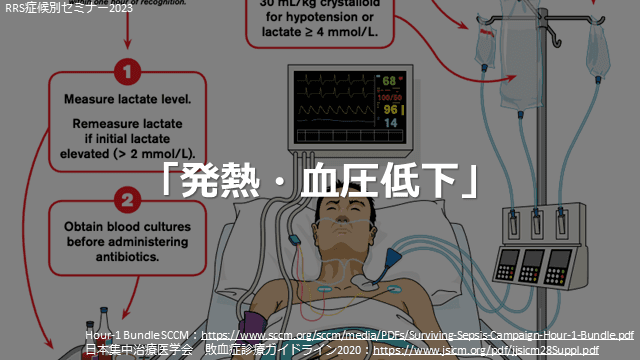
Septic shockに介入する:Hour-1 bundle 乳酸血を測定し、最初の乳酸値が2mmol/L(18mg/dL)以上の場合、繰り返し測定する 抗菌薬投与前に血液培養を採取する 広域スペクトラム抗菌薬を投与する 30ml/kgの晶質液を急速投与する(低血圧または乳酸値4mmol/L以上の場合) 血管収縮薬を輸液組成中または組成後に開始し、平均動脈圧を65mmHg以上に保つ SCCM:https://www.sccm.org/SurvivingSepsisCampaign/Guidelines/Adult-Patients
#40.
血管作動薬 第一選択は、ノルアドレナリン 足りないなら、バソプレシン それでもだめなら、アドレナリン
#41.
γ計算 1γ=1 [μg/kg/min] =1×体重 [μg/min] =1×体重×1/1000 [mg/min] =1×体重×1/1000×60 [mg/h] =0.06×体重 [mg/h] 1γ=0.06×体重(kg) [mg/h] 体重50kgの人であれば、1γ= 50kg×0.06 = 3.0 [mg/h] 体重75kgの人であれば、1γ= 75kg×0.06 = 4.5 [mg/h] 実際は、「ml/h」と表示されている 「いま、 どれだけの用量で流れている?」 ①まず濃度計算 当院の組成は、NE 5A(5mg/5ml)+NS 45ml 5mg÷50ml=0.1mg/ml ②濃度×流量でmg/hを計算 0.1mg/ml×5ml/h=0.5mg/h ③ γ =0.06×体重(kg) [mg/h] 0.5÷(0.06×50(kg)) =0.5÷3 =0.167γ NE持続 5ml/h、体重50kgとする
#42.
Take Home message ショックは「酸素需給バランスの不均衡」 3つの窓「脳」「皮膚」「腎臓」でショックを認知 初期対応:「VIP rules」+「RUSH exam」 管理:「酸素供給量」+「臓器灌流圧」を意識 Septic shockに「1-Hour bundle」を活用
会員登録・ログインで「スライド内のテキスト」を参照いただけます。